

From Seeking Recognition to Finding Stories
Marko Klavs — Fine Art Photographer
Years ago, I asked myself a question I couldn’t quite answer honestly at the time.
Why do I photograph?
For the joy of it? For creativity? For recognition? Or perhaps because I want other people to appreciate my photographs? At first, the answer seems simple. We photograph because we enjoy it. Because we want to capture a moment, create something beautiful, or show the world through our own eyes. But over the years, things can change.
When Photography Begins to Lose Its Meaning
I used to photograph mainly landscapes and rural scenes. I enjoyed being out in nature, searching for light and discovering moments I wanted to preserve. Gradually, however, I began to notice something that troubled me. On social media, certain photographs received a great deal of attention, while others received very little. Quite often, the photographs I personally valued the most attracted the least response. At first, I told myself that likes didn’t matter. But if I was truly honest with myself, I had to admit that they did influence me. When a photograph receives a lot of attention, it is tempting to create another one just like it. And then another. Somewhere along the way, I began to feel that I was no longer photographing entirely for myself. It was as though I had slowly started creating what other people wanted to see. That frustrated me. What troubled me even more was realizing that I had allowed other people’s reactions to influence something I loved so much.
Searching for My Own Expression
I didn’t want to give up photography. I simply wanted to rediscover the feeling that had made me pick up a camera in the first place. Gradually, I began exploring different photographic approaches. I had always been drawn to classical painting, especially the use of light, shadow, and the ability to tell a story through an apparently ordinary scene. I cannot paint with a brush. But I had a camera, my imagination, and a desire to create. I discovered the world of fine art still life photography and advanced photographic techniques. I began arranging objects, shaping light, and creating scenes I had first imagined in my mind. This time, I was no longer interested only in whether people would like the photograph. I wanted to know whether I could say something through it. And for the first time in a long while, I felt I had found my direction.
The Pear That Changed Everything
One photograph holds a special place in my artistic journey.
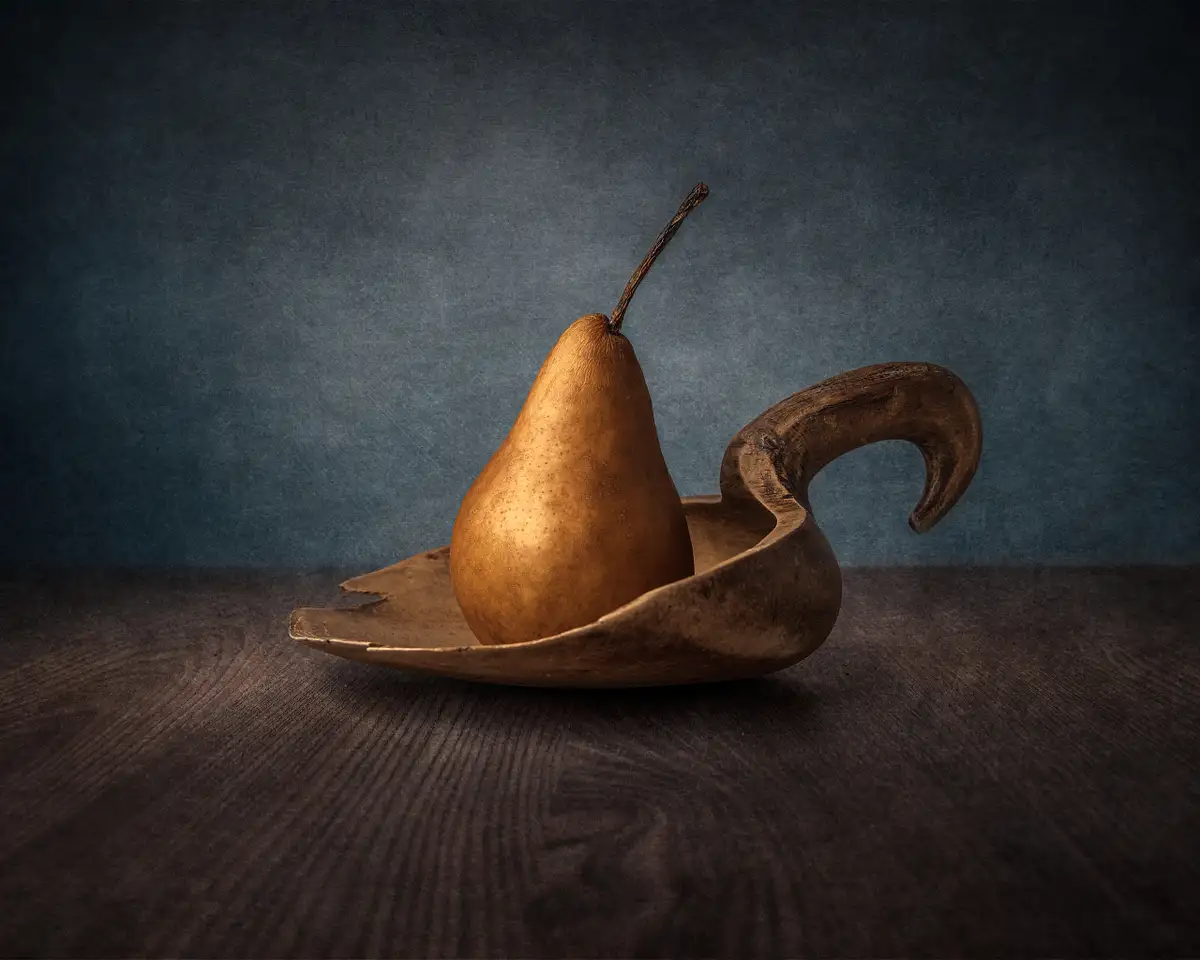
Pear on Spoon.
A simple subject. A pear and a spoon. But for me, this photograph was more than an exercise in lighting or composition. It was one of the first moments when I truly felt that an ordinary object could become the heart of a story. The image attracted attention and opened the door to the world of fine art still life photography. My first important recognition followed, giving me greater confidence and encouragement. Yet when I look back on that moment today, the award is not what matters most. What matters is realizing that I had created something meaningful to others. It encouraged me to trust my own instincts.
Objects That Carry Memory
Today, I create under the name Silent Objects.
My studio is filled with old cameras, clocks, books, scales, vases, and many other objects marked by the passage of time. Some are worn, damaged, or nearly forgotten. That is precisely what draws me to them. When I look at an old clock, I don’t simply see a mechanism that measures time. I think about all the time it has already witnessed. When I place an old camera beside a book, I wonder what story they might tell together. Sometimes inspiration comes from an object, sometimes from the light, and sometimes from a completely unexpected idea. But before I press the shutter, I want to see the final photograph in my mind. For me, that is essential. The photograph must first exist in my imagination. Only then can I begin to bring it to life. Light, composition, photography, and digital post-processing are the means through which I shape that vision. But the story remains the most important element.

What Does Recognition Mean to Me Today?
Of course, I appreciate it when my work receives recognition. Every artist hopes their work will resonate with someone. In recent years, I have experienced several important international successes. I am grateful for them because they have opened new opportunities and helped my work reach a wider audience. But my earlier experiences taught me something. Recognition can be an encouragement, but it should never become the reason to create. If I photographed only to please others, sooner or later I would find myself back where I once was. Feeling that I was losing what mattered most to me. The freedom to create.

So Why Do I Photograph?
Today, I can answer that question much more easily than I could years ago. I photograph because I enjoy it. Because I love creating worlds that first exist only in my imagination. Because I am drawn to light, shadows, old objects, and the stories they carry. Because photography allows me to express something I might not be able to put into words or paint with a brush. Above all, I photograph because I believe that every image can communicate something to another person. I don’t expect everyone to interpret my photographs in the same way. One person may see time in an old clock, another may see memory, and a third may see nothing more than an object. Everyone can discover their own story in a photograph. And to me, that is its greatest value.
If someone discovers a story in my photograph, I have achieved my goal.
Marko Klavs · Silent Objects
 ) to see how your blog looks